Photogrammetry Pipelines Capture Hyper-Detailed Environments for Seamless Asset Integration Across Console Libraries and Portable Kits
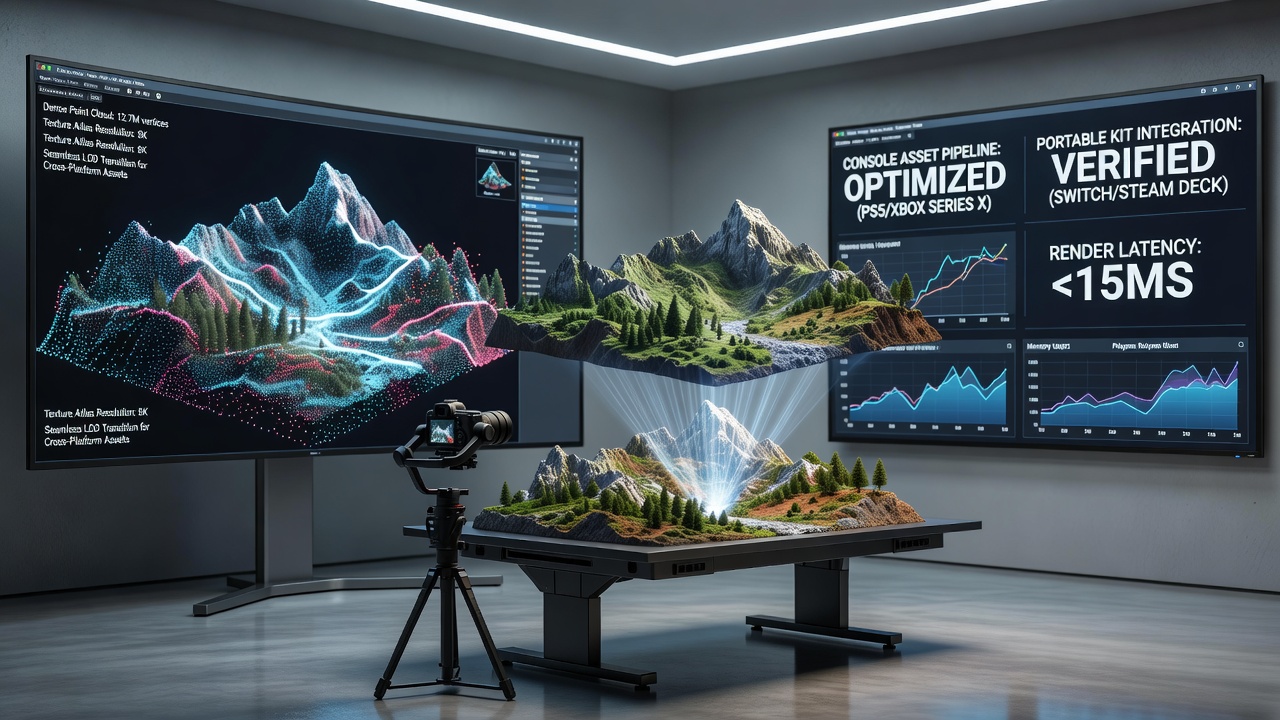 Developers rely on photogrammetry pipelines to generate hyper-detailed 3D environments that transfer directly into asset libraries for both stationary consoles and portable development kits. These systems combine high-resolution photography with computational reconstruction to produce geometry, textures, and materials that maintain visual fidelity while meeting platform-specific performance constraints. Research indicates that studios have integrated these methods into production workflows since the mid-2010s, yet refinements continue to address bandwidth and memory limitations across device generations. The process begins with multi-angle image capture using calibrated camera arrays, followed by structure-from-motion algorithms that align photographs into point clouds. Software then converts these clouds into polygon meshes, normal maps, and albedo textures optimized for real-time rendering. Teams apply decimation tools and LOD generation scripts early in the pipeline so that the same source data supports both high-end console builds and lower-power portable kits without requiring separate capture sessions.
Technical Components of Modern Photogrammetry Workflows
Observers note several core stages that determine output quality and cross-platform compatibility. First, lighting consistency during capture prevents artifacts that later require manual cleanup. Second, automated UV unwrapping and texture baking reduce artist hours while preserving detail density. Third, material authoring software converts captured reflectance data into PBR-compliant shaders that behave predictably under different rendering engines used by console manufacturers and portable hardware vendors.
Engineers frequently combine photogrammetry with procedural augmentation so that captured surfaces receive additional weathering or variation layers. This hybrid approach allows a single environment scan to serve multiple titles within a shared library while developers adjust parameters for each platform's target resolution and draw-call budget.
Cross-Platform Asset Optimization Practices
Asset pipelines now incorporate automated validation steps that test geometry and texture budgets against specifications published by console certification programs and portable kit documentation. These checks flag overdraw issues or excessive vertex counts before assets move downstream. Studios run parallel builds that target different compression formats, ensuring textures remain crisp on high-bandwidth console storage yet fit within portable memory pools after mip-chain reduction.

What's interesting is how middleware solutions have standardized export formats that preserve photogrammetry-derived detail during conversion. Data shows that companies adopting these standards reduced asset re-authoring time by measurable percentages between 2023 and 2025. In June 2026, several major publishers reported that their internal pipelines now route photogrammetry outputs through a unified graph that automatically generates platform variants, eliminating manual handoffs that previously introduced inconsistencies.
Industry Adoption and Data Trends
Academic studies from institutions such as the University of British Columbia highlight efficiency gains when photogrammetry feeds directly into shared asset repositories. According to a 2025 report by the Interactive Software Federation of Europe, studios utilizing integrated capture-to-deployment pipelines achieved faster iteration cycles across multi-platform projects. These figures reveal that environment assets originally captured for console titles now appear in portable releases with minimal visual degradation after targeted optimization passes.
Teams continue to refine camera calibration protocols and GPU-accelerated reconstruction algorithms. The result is higher polygon budgets that still respect thermal and power limits of portable kits while delivering the same geometric complexity found in stationary console versions.
Conclusion
Photogrammetry pipelines have matured into reliable components of cross-platform asset production. Continued advances in capture hardware, reconstruction software, and automated optimization scripts support consistent environment detail across console libraries and portable development kits. As hardware specifications evolve, these workflows adapt through updated validation rules and format converters that preserve the fidelity achieved during initial scanning sessions.