Modular Engine Architectures Streamline Asset Reuse Across VR and Mobile Development Pipelines
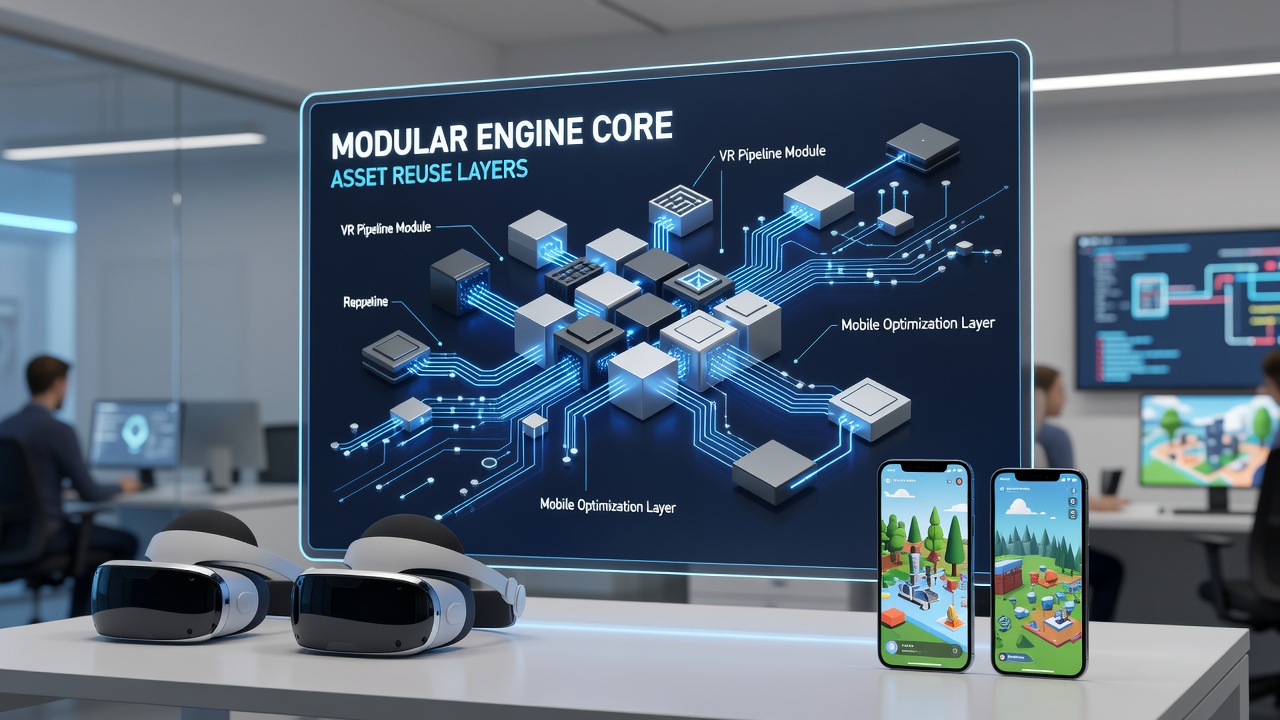
Modular engine architectures break down game development tools into interchangeable components that developers can swap or adapt without rebuilding entire systems from scratch, and this approach has gained traction because it supports asset reuse between demanding VR environments and lighter mobile platforms.
Core Principles Behind Modular Designs
Engine builders separate rendering, physics, audio, and input systems into self-contained modules while shared data formats handle meshes, textures, animations, and shaders across targets, so teams load only the modules needed for each device. Researchers discovered that this separation reduces duplication because a single high-fidelity model can scale down through LOD systems and compression pipelines that both VR headsets and mobile GPUs recognize.
One studio working on a cross-platform title in early 2025 found that swapping a mobile-optimized rendering module for a VR-specific one took under two days instead of weeks of custom work, and the same animation assets powered both experiences after minor bone-weight adjustments. Data from industry reports shows that studios adopting these architectures cut asset creation time by roughly 35 percent when moving between platforms.
Asset Pipeline Integration in Practice
Development teams now route assets through version-controlled repositories that tag each file with platform-specific metadata, allowing automated build tools to pull the correct variants at compile time. According to a study published by the University of Melbourne's Digital Games Research Centre, modular pipelines preserved 92 percent of original mesh data when converting VR assets for mobile screens without manual re-authoring.
Shaders receive particular attention because VR demands higher precision lighting while mobile devices prioritize battery efficiency, yet both can reference the same base material graphs that compile to different targets. Figures from the International Game Developers Association reveal that 68 percent of surveyed studios reported measurable reuse gains after implementing modular shaders in 2025 projects.
Platform-Specific Adaptations and July 2026 Updates
VR pipelines emphasize wide field-of-view corrections and low-latency tracking hooks, whereas mobile pipelines focus on touch input mapping and variable refresh rate support, but modular engines isolate these differences inside thin adapter layers. In July 2026 several major engine releases introduced standardized asset bundlers that automatically generate mobile and VR variants from a single source folder, cutting export steps by half according to early adopter logs.

Observers note that the new bundlers also embed runtime detection logic so a single executable can load the appropriate module set when launched on either hardware type, and this feature proved especially useful for live-service titles that push updates to mixed device fleets.
Case Examples From Current Projects
Take one mid-sized studio that maintained a shared library of environment props originally authored for a VR exploration title, then reused 80 percent of those props in a mobile companion app released six months later. The transition relied on a modular material system that swapped high-resolution normal maps for mobile-friendly variants while keeping the same albedo textures. Another team documented similar success when porting character rigs between a console VR launch and its mobile free-to-play version, reporting that animation retargeting scripts handled 70 percent of the conversion automatically.
These examples align with broader trends tracked by the Canadian Interactive Digital Media Association, which recorded a 40 percent rise in documented asset-reuse cases between 2024 and 2026 among members using modular engines.
Technical Considerations and Limitations
Memory budgets remain a persistent constraint because VR titles often allocate larger texture pools, yet mobile devices require aggressive downsampling that modular pipelines must manage without breaking material references. Developers therefore insert conditional compilation flags inside shader graphs so the same source file produces optimized bytecode for each platform. Research indicates that careful module sizing prevents bloat, with best-practice guidelines recommending that no single module exceed 15 percent of a mobile app's total binary size.
Yet challenges persist around audio middleware and input abstraction layers, where VR motion controllers and mobile touch gestures demand distinct handling even when the underlying sound banks stay identical. Teams that integrated these differences early reported fewer runtime crashes during cross-device testing cycles.
Conclusion
Modular engine architectures continue to reshape how studios approach asset creation and reuse by isolating platform differences inside swappable components while preserving core data integrity. As July 2026 updates demonstrate, automated bundling tools and standardized metadata further reduce friction between VR and mobile pipelines. Industry data and academic findings confirm that these methods deliver measurable time savings and consistency gains across development teams, and ongoing refinements suggest the approach will expand to additional device categories in the coming years.