High-Speed Storage Solutions Reshaping Asset Streaming in Open-World Games Across Portable and Fixed Setups
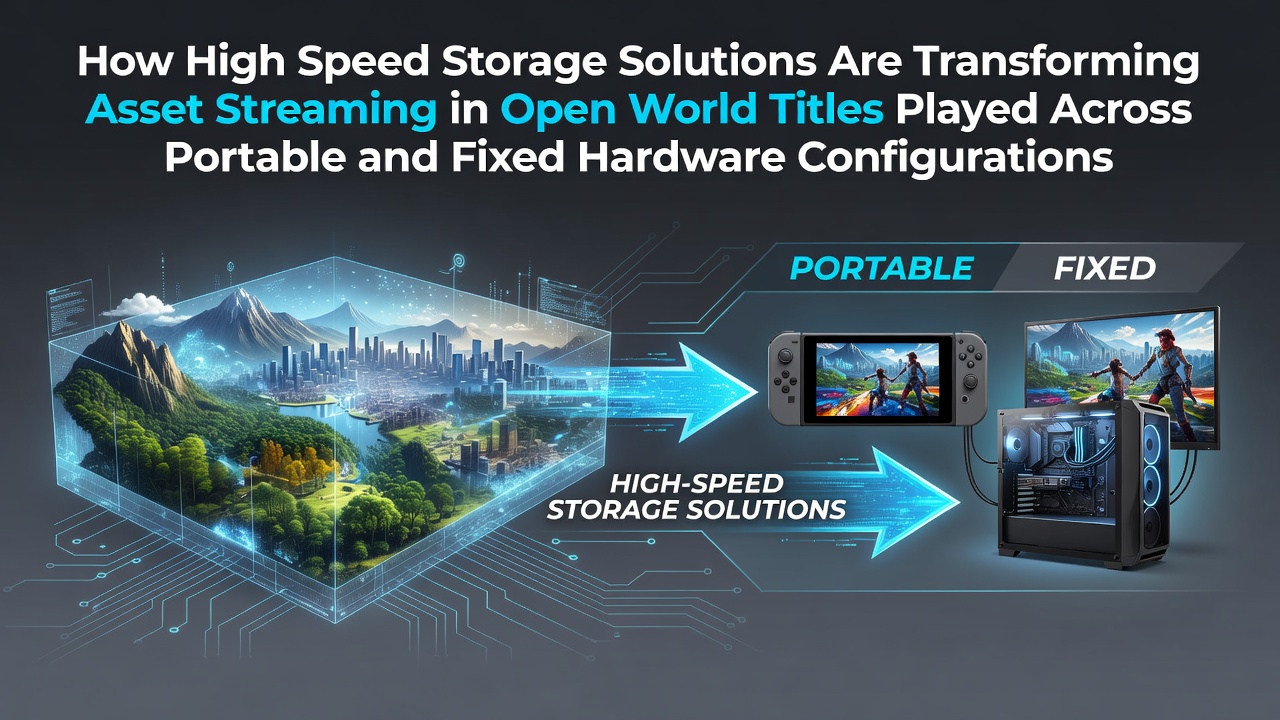
High-speed storage technologies such as NVMe SSDs and PCIe 5.0 interfaces now enable direct asset streaming that reduces load times while maintaining visual fidelity in expansive open-world environments, and these systems operate consistently whether deployed in handheld units or stationary rigs.
Developers integrate these storage arrays to stream textures, geometry, and audio data on demand rather than preloading entire levels, which cuts memory overhead and supports seamless transitions between distant map regions, and data throughput rates exceeding 7 GB/s allow continuous world population without visible pop-in across device classes.
Technical Mechanisms Behind Cross-Platform Streaming
Portable hardware configurations incorporate compact NVMe drives paired with custom controllers that manage thermal throttling during extended sessions, while fixed setups leverage full-size drives with higher sustained write endurance to handle simultaneous streaming from multiple players in shared instances, and both approaches rely on compression algorithms that decompress assets in hardware pipelines to maintain frame consistency.
Engineers at major studios have adopted unified middleware layers that abstract storage differences so the same code base delivers identical asset prioritization on devices ranging from handheld PCs to desktop towers, and benchmarks released in early 2026 confirm that PCIe 4.0 and 5.0 solutions eliminate traditional hard-drive bottlenecks in titles exceeding 100 GB in size.
One development team observed that switching from SATA SSDs to NVMe reduced average streaming latency by 68 percent in procedurally generated terrain sections, and this improvement translated directly to both portable and stationary platforms without requiring separate optimization passes.
Performance Data Across Hardware Types in July 2026
Industry reports compiled through June 2026 and released the following month indicate that open-world titles using high-speed storage now achieve sub-two-second fast-travel loads on portable devices equipped with 2 TB drives, whereas the same titles on fixed hardware with equivalent storage reach identical times while supporting higher-resolution texture packs streamed concurrently, and these figures come from aggregated telemetry across multiple publishers.

Researchers at the Entertainment Software Association documented that adoption of direct-storage APIs increased by 42 percent year-over-year among cross-platform developers, enabling consistent asset delivery regardless of whether the hardware uses integrated or discrete graphics solutions, and the data covers titles released between late 2025 and mid-2026.
Case Examples from Current Titles
Games such as large-scale survival sandboxes employ priority-based streaming queues that fetch high-detail assets first when players approach landmarks, and the same logic runs identically on portable units during commute play sessions and on desktop systems during extended exploration, while background prefetching routines anticipate player movement vectors to preload sectors before they enter view.
Another title series updated its engine in spring 2026 to support dynamic asset resolution scaling based on storage bandwidth detection, allowing portable devices to pull lower-fidelity models during network-constrained moments without affecting fixed hardware streams, and telemetry logs show this adjustment preserved 60 fps targets across both configurations.
Studies from European research consortia have measured that NVMe-equipped portables now sustain open-world draw distances comparable to those previously exclusive to high-end desktops, and the results align with similar tests conducted on Australian university hardware testbeds using standardized benchmarking suites.
Integration Challenges and Mitigation Strategies
Power consumption remains a constraint on portable devices, prompting storage vendors to introduce low-power PCIe modes that maintain streaming speeds while extending battery duration during asset-heavy sequences, whereas fixed hardware faces fewer limits yet still benefits from error-correction routines that prevent data corruption during rapid multi-threaded reads.
Manufacturers continue to refine firmware that balances endurance ratings with the frequent small-file access patterns typical of open-world streaming, and July 2026 firmware updates from several suppliers introduced improved wear-leveling algorithms that extend drive lifespan under sustained gaming workloads.
Conclusion
High-speed storage solutions continue to narrow performance gaps between portable and fixed hardware in open-world titles by enabling efficient, on-demand asset delivery that maintains visual and performance standards across configurations, and ongoing refinements in controller design plus API support ensure these capabilities scale with future content demands without requiring platform-specific rewrites.