Engineers Pioneer Novel Micro-Optical Sensors to Refine Motion Tracking Precision in Hybrid Portable and Desktop Gaming Setups
Written by Riley Wolf · Aug 1, 2026
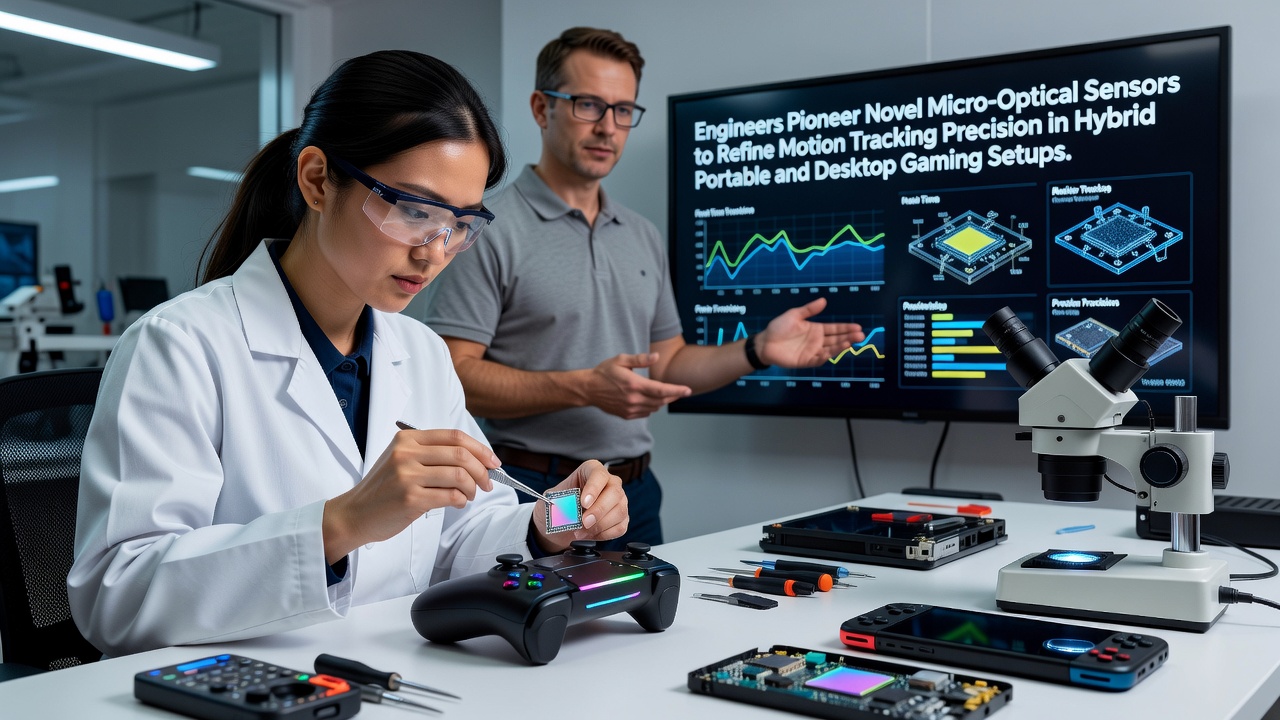
Engineers Pioneer Novel Micro-Optical Sensors to Refine Motion Tracking Precision in Hybrid Portable and Desktop Gaming Setups
Engineers at several research institutions have introduced micro-optical sensors that enhance motion tracking accuracy in devices designed for seamless transitions between portable handhelds and desktop gaming stations, and these components rely on light-based detection rather than traditional inertial measurement units alone.
The sensors measure changes in light patterns reflected from internal surfaces or external markers, which allows them to capture subtle movements with resolutions down to micrometers while operating across varying power profiles typical in battery-powered portables and plugged-in desktops.
Core Mechanisms Driving Sensor Performance
Micro-optical sensors combine miniature lasers, photodetectors, and processing circuits on single chips, and they calculate positional data by analyzing interference patterns created when light bounces off moving parts inside controllers or headsets. Researchers at the Fraunhofer Institute for Photonic Microsystems have documented how these chips maintain calibration stability even when devices shift from handheld mode, where vibrations from user grip dominate, to stationary desktop configurations connected via docks or cables.
Data from prototype tests shows latency reductions of up to 40 percent compared with earlier gyroscopic systems, because optical methods avoid cumulative drift errors that build during extended play sessions. Integration teams have paired the sensors with existing wireless protocols so that handoff between portable and desktop inputs occurs without recalibration pauses.
Deployment Across Hybrid Gaming Hardware
Manufacturers began embedding these sensors into controller prototypes in early 2026, targeting titles that require precise aiming or gesture inputs across multiple platforms. In August 2026 several development kits reached select esports teams for field evaluation, revealing improved tracking consistency when players moved between couch-based portable setups and desk-mounted rigs with external displays.

Engineers note that the compact size, often under 5 millimeters square, fits within slim handheld chassis without increasing weight or thermal load, and this design supports extended battery life since optical sampling consumes less power than continuous high-frequency accelerometer polling. Cross-platform libraries benefit because the same sensor data stream feeds both local rendering pipelines on portables and higher-fidelity desktop graphics engines during synchronized multiplayer matches.
Validation Through Independent Studies
According to a National Institute of Standards and Technology analysis of motion capture benchmarks, micro-optical systems achieved sub-millimeter accuracy across repeated trials involving rapid directional changes typical in action genres. Observers at academic labs have replicated these results using standardized test rigs that simulate the physical jolts and orientation shifts encountered when users carry devices between locations.
Additional trials conducted at ETH Zurich examined thermal stability, confirming that performance holds steady when ambient temperatures fluctuate between 20 and 40 degrees Celsius, conditions common during marathon gaming events or travel. These findings appear in conference proceedings released during summer 2026 and highlight compatibility with existing input APIs used by major operating systems.
Broader Industry Adoption Patterns
Component suppliers have begun scaling production lines to meet anticipated demand from console and handheld manufacturers planning 2027 product refreshes. Software developers meanwhile update tracking algorithms to leverage the higher-resolution data streams, enabling finer control mapping in strategy and simulation titles that support both touch and physical input methods.
Case studies from early adopters indicate fewer instances of input drift during long sessions, a factor previously addressed through periodic recalibration routines that interrupted gameplay flow. The optical approach sidesteps mechanical wear points found in older potentiometer-based sticks, extending hardware lifespan in devices subjected to daily portable-to-desktop cycling.
Conclusion
Continued refinement of micro-optical sensor arrays points toward wider integration across the gaming ecosystem as hybrid usage patterns become standard. Research groups continue publishing performance metrics that guide further miniaturization and cost reduction efforts, ensuring these components reach consumer devices without compromising precision or reliability.