Adaptive AI Scripting Refines Enemy Behavior Patterns in Cross-Platform Strategy Titles During Live Esports Broadcasts

Adaptive AI scripting adjusts enemy responses in real time within strategy titles that run across PC, console, and mobile platforms, and these adjustments appear during live esports broadcasts where matches unfold under constant observation. Developers implement scripting layers that analyze player inputs and match data to modify patrol routes, attack priorities, and resource allocation on the fly, which creates varied encounters that reflect ongoing competition dynamics. Research from university labs indicates such systems process telemetry streams to update behavior trees without requiring server restarts, while figures from industry reports reveal deployment in titles supporting simultaneous play sessions on multiple devices.
Core Mechanisms Behind Real-Time Enemy Adjustments
Scripting engines pull data from player positions, unit compositions, and resource expenditures to recalibrate enemy decision matrices, and this process integrates with cross-platform synchronization protocols that maintain consistency whether participants compete on high-end PCs or portable handhelds. Observers note that machine learning overlays refine these matrices by weighting recent match events more heavily, which allows enemies to shift from defensive formations to flanking maneuvers when broadcast commentators highlight emerging patterns. Data shows these updates occur within milliseconds during peak tournament moments, whereas traditional static scripts often repeat sequences that skilled competitors exploit quickly.
Engineers integrate reinforcement learning modules that reward behaviors leading to prolonged engagements, and such modules draw from aggregated session logs across device types to balance difficulty without manual intervention. In practice, an enemy squad might reroute supply lines after detecting repeated aerial strikes, yet the same squad could adopt stealth protocols if mobile players demonstrate different movement speeds. Studies from academic institutions demonstrate that these layered scripts reduce predictability while preserving performance stability across network conditions typical of global esports venues.
Cross-Platform Synchronization Challenges
Strategy titles must account for input latency variations and hardware rendering differences when applying adaptive scripts, since console controllers register commands at different intervals than touch interfaces or keyboard setups. Researchers discovered that predictive interpolation layers smooth these discrepancies, which enables enemies to respond uniformly regardless of the platform each competitor uses. Figures from 2025 tournament analyses indicate that synchronization failures dropped after implementation of unified AI state machines, although residual issues surface during high-bandwidth broadcast streams when multiple camera angles compete for server resources.
Engineers deploy middleware that translates behavior outputs into platform-specific visual and audio cues, and this middleware ensures spectators watching on varied devices perceive the same tactical shifts. Those who have examined code repositories note that version control systems track script iterations across development teams located in different regions, which supports rapid iteration cycles ahead of major events. In June 2026, several regional qualifiers tested updated middleware builds that further minimized desync during simultaneous PC and mobile matches.
Integration With Live Broadcast Production
Broadcast teams incorporate AI scripting telemetry into overlay graphics that display enemy adaptation metrics, and these overlays help viewers understand why certain units alter paths mid-engagement. Production software pulls anonymized logs to generate heat maps showing behavior changes, which appear alongside player statistics without exposing proprietary code. Industry organizations report that such integrations increase audience retention by providing context for seemingly erratic enemy actions that actually stem from scripted responses to live match conditions.
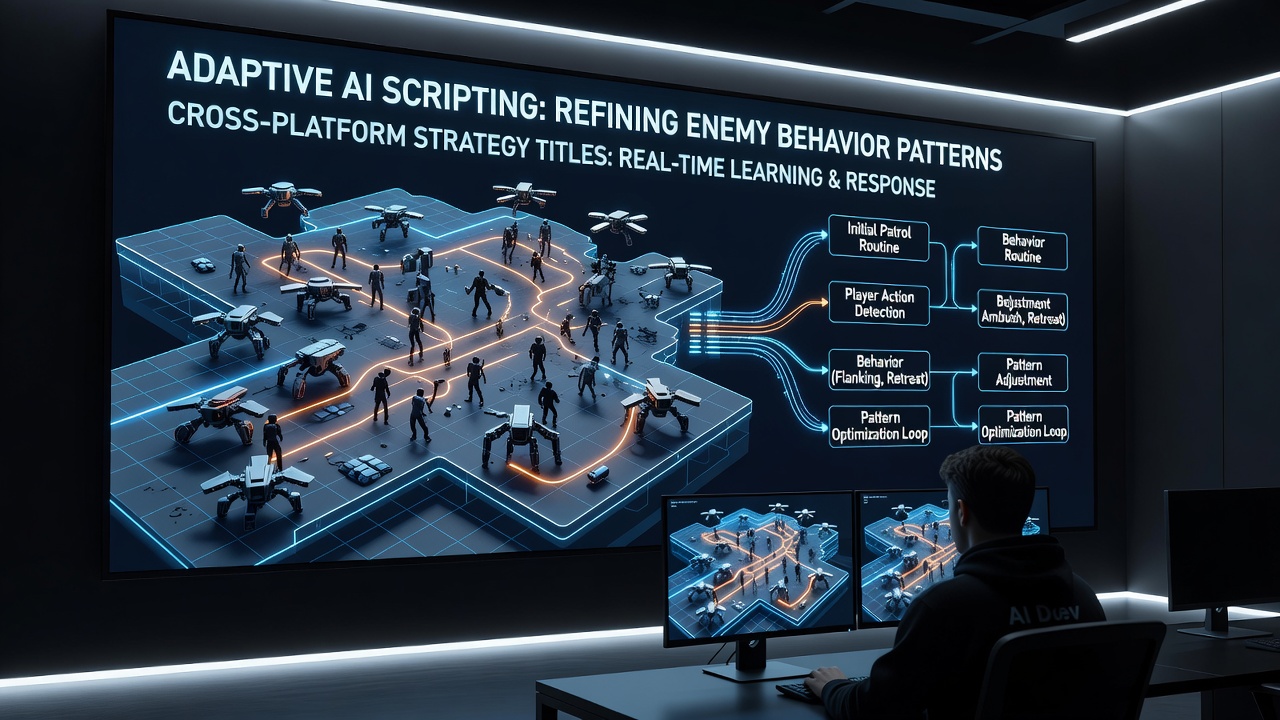
Commentators receive briefings on common adaptation triggers, yet the scripting itself remains opaque to prevent reverse-engineering during ongoing series. Data from broadcast analytics platforms shows that segments featuring visible AI shifts correlate with higher social media engagement, while technical directors adjust camera priorities to capture moments when enemies execute newly scripted maneuvers. This workflow connects game servers directly to production pipelines through secure APIs that filter sensitive information before public display.
Case Examples From Recent Tournament Circuits
During qualification rounds held in early 2026, one title updated its enemy reinforcement logic after observing consistent player strategies across console and PC brackets, and the update manifested in altered spawn timings that forced competitors to adjust mid-series. Tournament organizers documented these changes through post-match reports that compared pre- and post-update engagement durations. Another circuit implemented regional server clusters that hosted localized AI instances, which allowed mobile participants in separate time zones to face behavior patterns calibrated to their device constraints while maintaining parity with stationary competitors.
Academic papers presented at gaming conferences detail how scripting teams collaborated with platform holders to embed diagnostic hooks, and these hooks supplied anonymized data streams used for post-event tuning. Observers note that such collaborations accelerated refinement cycles, particularly when matches spanned multiple continents and required unified behavior across diverse network infrastructures.
Technical Limitations and Ongoing Refinements
Memory constraints on mobile hardware limit the depth of behavior trees that can run concurrently with rendering pipelines, which prompts developers to offload complex calculations to cloud instances during connected sessions. Research indicates hybrid execution models reduce frame drops while preserving adaptation quality, although latency spikes occasionally delay script application during crowded broadcast periods. Trade groups have compiled guidelines that recommend minimum hardware baselines for consistent AI performance across device classes.
Future iterations explore federated learning approaches that aggregate insights without centralizing raw player data, and early tests suggest these methods enhance enemy variety while addressing privacy considerations common in international competitions. As circuits prepare for expanded 2026 schedules, scripting frameworks continue to evolve through iterative testing that incorporates feedback from both professional and amateur brackets.
Conclusion
Adaptive AI scripting continues to shape enemy responses in cross-platform strategy esports by processing live match data into targeted behavior updates that function consistently across device types. Broadcast integrations provide spectators with clearer views of these adjustments, and ongoing technical developments address synchronization and hardware limitations that once constrained broader adoption. Tournament records and research outputs document measurable impacts on match dynamics, which establishes a foundation for further refinements as platforms adn audiences expand.